
How can the Vatican and Anthropic help catalyze a proper US-China-led AI treaty?
by Rufo Guerreschi — June 4th, 2026
While the Pope's AI encyclical released on May 25th is undoubtedly a landmark of moral guidance for the digital era, it is overall more notable for its shocking omissions on AI safety risk. Across 42,000 words, there was not a single mention of "AGI” or Artificial General Intelligence, nor of "ASI" or "Superintelligence", nor the "(Technological) Singularity".
Though he did state "Humanity — in all its grandeur and woundedness — must never be replaced or surpassed.", shockingly, the document shockingly avoided terms like "extinction risk" "existential risk" "loss of control risk" or even the word "safety" — omissions mirrored in the silence of the Anthropic co-founder who joined him.
It was so out of sync with the established consensus of seriousness and urgency of those risks that it felt like an AI ethics paper from 2022, as Shakeel Hasim observed.
Yet, as we’ll argue in detail below, such omissions were most likely part of a joint strategy aimed at deflecting an extremely powerful AI political front led by Peter Thiel and his network, which has oddly but steadily and forcefully warned against the leaders of a future movement for a strong global AI treaty — to counter purported immense safety or extinction risks — as constituting or abetting the Antichrist and hiddenly pursuing a global tyranny.
By demanding institutional change to prevent the runaway concentration of AI wealth and power — rather than to prevent extinction — the Pope and Olah were, in effect, calling for the very same institutions that catastrophic-risk prevention requires. Any genuine democratization of AI power must begin by reliably denying anyone the capacity to impose catastrophic safety or extinction risks on the rest of us. That capacity is the ultimate concentration of power. And denying it durably requires exactly what we propose: a bold AI treaty.
This strategy makes their call for international action and cooperation much more agreeable by powerful members of the Trump administration like Rubio, Vance and Kratsios — at a time when the Trump administration is forced to confront the safety and security risks of AI (Anthropic’s) that have proven scalably superhuman at hacking capabilities.
Consequently, a continued strategic alignment between the Vatican and Anthropic could prove vital in promoting a comprehensive AI treaty designed to mitigate both AI's immense safety and power concentration risks, ultimately unlocking AI’s profound potential for all humanity.
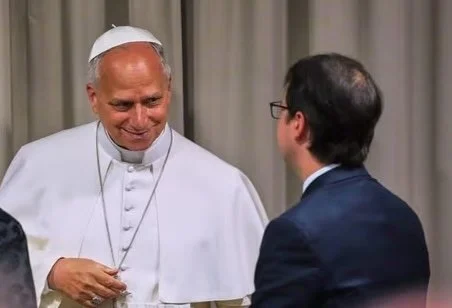
On May 15th — the 135th anniversary of Pope Leo XIII'sRerum Novarum — Pope Leo XIV signed his long-awaited AI encyclical,Magnifica Humanitas. Ten days later he would present it in person at the Vatican Synod Hall — alongside two theologians, two Vatican officials, and Anthropic co-founderChris Olah.
A few days after the announcement, I wrote a detailed blog post based on extensive prior research, suggesting that a Vatican-Anthropic alignment could help foster the extraordinarily bold and timely US-China-led AI treaty that we desperately needed — by catalyzing a critical mass of key potential influencers of AI policy to persuade Trump.
May 25th validated our vision and provided strategic elements for an actionable path. For the first time in Church history, the Pope chose to present an encyclical in person at a public event. Just as unforeseen, the Pope made it so that his own 1,200-word address was preceded by one of similar length by Mr. Olah, an atheist business leader, billionaire and researcher. Given the content of those speeches, their anticipation, and staging, those speeches acted as the de facto executive summaries of the 42,000-word encyclical.
After lengthy thanks of the other speakers, his predecessors and those who he engaged during his drafting of the encyclical, the Pope unveiled the essence he wants the world to take away from his encyclical:
From this listening matured a disturbing conviction expressed in Magnifica Humanitas: artificial intelligence needs to be disarmed. The word is strong, I know, but deliberately chosen because this moment needs words capable of attracting attention, awakening consciences and indicating paths forward for humanity.
The Church has long been working for nuclear disarmament, aware that every great technical power can affect people’s lives and so must be accompanied by adequate moral discernment and public control. Nuclear disarmament remains a service to peace and the dignity of the human family.
Here historical clarity matters. While stated as a political aspiration by most US presidents (and some Soviet ones) since WW2, nuclear disarmament has never gone beyond a one-liner statement of intention. Not even a single-page proposal was ever advanced.
A stark and much-forgotten exception is the proposal that gives a name to our Coalition for a Baruch Plan for AI. On June 14th, 1946 — Donald Trump's birthday,within one hour of his birth — Bernard Baruch, on behalf of President Truman, formally presented to the UN theBaruch Plan. It was and still is by far history's boldest treaty proposal. It prescribed in fine detail the creation of a treaty organization for the exclusive international control of all dangerous nuclear arsenals, fissile materials, facilities, and research. It was built on theAcheson-Lilienthal Report, the result of months of deep multidisciplinary work by the very top US diplomats and scientists, led by Robert Oppenheimer.
"Disarming, however, is not enough. We must build." wrote the Pope in the encyclical. Along such lines, the Plan also prescribed full sharing of the state-of-the-art nuclear energy technology as a positive incentive for nations to abide by the nuclear weapons bans.
The Baruch Plan was countered by a Soviet counter-proposal five days later. It was approved 10–2 in the UN Atomic Energy Commission, with the Soviet Union and Poland abstaining, but ultimately stalled under Soviet refusal and wasshelved by 1948. Most historiansagree the Plan's narrow failure traces to two causes: a severely limited diplomatic bandwidth in Washington and Truman's decision in the fall of 1945 to ignore the recommendations of his Secretary of War Henry Stimson, of former Vice President Henry Wallace, and of Deputy Secretary of State Dean Acheson — all of whom urged him to seek a solid initial agreement with the Soviets first, rather than first locking in his Western allies.
Remarkably, exactly such an approach was articulated as the Trump administration's chosen one byOSTP Director Michael Kratsios at the UN Security Council in November 2025, when he called for a "cooperation of statesmen" as the alternative to the UN or multilateral processes for AI which the administration "totally rejects." That, alongside the date alignment with Trump's birth, gives us two real points where history seems to be leaning in.
Why was Mr. Olah there?
Despite the evident mutual moral recognition in their staging, and even an appearance of personal affection, the Pope did not invite Olah to show the world the Vatican and Anthropic think alike, but the exact contrary.
In his speech, Olah provided a humbly-delivered but starkly clear statement supporting AI consciousness, AI's moral value and the ability of humans to choose ASI character, which were clearly contradicted by the Pope in the encyclical. Olah stated:
"I lead a research team that studies the internal structure of these models — what is actually happening inside them. And I will be honest: we keep finding things that are mysterious, even unsettling. We find structures that mirror results from human neuroscience. We find evidence of introspection. We find internal states that functionally mirror joy, satisfaction, fear, grief, and unease. I don't know what that means, but I think it warrants ongoing discernment." (full remarks)
Following that, the Pope remarked in the clearest of ways how distant his positions are from those of Olah and Anthropic on such critical matters:
In a special way I would like to thank Mr Olah for accepting our invitation. In turn, in the name of the Church, I accept your invitation to walk together, to listen and to speak and together to find the way for humanity, in this time of artificial intelligence.
What a great sign of hope that, with our differences, we can listen to one another.This interchange clearly bespeaks the gravity of the moment, as well as confidence that, together, we can discern the major questions of our time, and so, the future of humanity.
The Pope had Olah there to bring into the open a debate on three questions that are crucial to every AI lab leader's posture on governance, but which have gone to date unspoken:
The possibility and likelihood of AI consciousness and its quality
The moral value of AI systems, if they have consciousness;
The ability of labs to reliably and durablyinstill values in AI or ASI (something Olah implies they'll be able to do — "what character we choose", Olah stated).
The Pope rightly believes that how lab leaders will adjust probabilistic replies to these questions — or find common ground on them — will shape the decision they face in the coming months: whether to (a) keep racing toward superintelligence, hoping to win and hoping the values they embed will hold; or (b) while racing, as competition forces them to, throw decisive weight behind a last-ditch effort at a proper AI treaty.
Perhaps, the Vatican should recall its history of giving low or no moral value to slaves, humans of other religions, and animals — and the immense suffering that has caused. It may want to be more cautious and open this time by considering the possibility of a moral value of certain AIs, regardless of the decision (that humanity will hopefully deliberately make) to allow or not their creation.
In our pre-encyclical post we optimistically wrote, "As odd as it may sound, an intense and explicit dialogue will be needed to arrive at shared, probabilistic and explicit determinations about such deeply-uncertain ASI predictions — not only between Anthropic and the Vatican but also among other key actors."
While an even marginal change of mind by the Pope is very difficult — given how clear he was in the encyclical and even in an X post following it — an outright or implicit acceptance of the possibility that something of moral value may arise in AIs, is possible. It may be something similar to the deep respect and value the Church has learned to give to other religions. This would make it easier to find a common ground and political platform with many techno-humanist AI lab leaders for a joint vision of an AI treaty..
A Deafening Silence
And yet, in 42,000 words and the two speeches combined, there is no mention of "risk of loss of control,", "treaty", "superintelligence," "extinction risk," "existential risk," or even the mere word "safety." And all that while making his central message to compare AI with the risks of nuclear weapons, the need for nuclear disarmament, calling for an "AI disarmament".
According to most top scientists, AI lab leaders themselves and even citizen surveys, those are the most critical issues, and they were completely omitted. They are central to Anthropic CEO Dario Amodei who estimated his risk of human extinction by ungoverned AI (or "pdoom") to be between 10-25% as early as in 2023 and more recently stated there is a 25% chance of AI going "really really bad".
His longtime Head of Policy and now head of the Anthropic Institute, Jack Clark — who called for a Baruch Plan for AI in 2023 — recently estimated there is a 30% chance that by 2027 we'll lose control of AI. They are central to most top AI scientists and other lab leaders and, in poll after poll they are central to citizens: 63% of US voters believe humans will lose control of AI, and 53% believe AI will likely destroy humanity.
So why this deafening silence by both institutions?
There is no possibility that the Pope or key Vatican AI thinkers advising him — whom I know or have studied closely — are unaware of the gravity and likelihood of the loss of control risk and other catastrophic safety risks. They are all well-informed and scientifically minded. The Pope’s leading AI advisor Benanti led aSeptember 2025 Coexistence appeal, and co-signed by Bengio, Russell, Hinton, and Harari, that explicitly called for "a binding international treaty establishing red lines" on precisely those risks of loss of control. Msgr. Tighe and Card. Fernandez stated in the Vatican's January 2025 Antiqua et Nova, many researchers believe that the "technology poses an “existential risk” by having the potential to act in ways that could threaten the survival of entire regions or even of humanity itself. This danger demands serious attention". Pope Francis called for a binding AI treaty as early as late 2023, shortly after the Bletchley Declaration. Archbishop Gallagherwarned the UN Security Council of "the rapid integration of AI into conventional and nuclear weapon systems," and said this is "not an abstract or distant concern, but an urgent reality." The former Holy See's UN observer, now nuncio to the US, Archbishop Caccia, has called AI regulation "imperative" and urged a "fundamental change in perspective" to safeguard humanity. Most notably, the very Vatican Secretary of State, Parolin, urged the world in 2025 to "establish a coordinated local and global governance of AI." and then stated "Are we standing at the threshold of a new era, or will human beings sooner or later bring about their own extinction through the introduction of artificial forms of life?"
The question remains: why the silence? Such a decision was, we believe, a calculated joint strategic move by both institutions necessitated by challenging strategic political conditions. By omitting any AI safety risk language, they aimed to neutralize the "Antichrist" framing advanced by Thiel. This narrative characterizes influential figures who warn of catastrophic AI safety risks as authoritarians constituting the Antichrist or unwittingly laying the groundwork for it. This strategy was underscored in March when, as it was widely reported, Thiel conducted four day days of private lectures on this very subject in Rome, a short walk from the Vatican.
The complete omission of the word "safety" from the encyclical gave for example Vice President Vance political room to come back to endorse the Pope’s AI stance, albeit very generally. Within 24 hours, in fact, Vance called the encyclical "very profound", in a return to the position he stated to Ross Douthat in May 2025: that "the American government is not equipped to provide moral leadership" on AI, and "the Church is”. This came after in September Thiel starkly criticized Vance for seeming to aim at a papal-Caesarist fusion abetting the Antichrist and Vance unusually harsh rupture with the Pope over his criticism on the Iran War. Even more significant, following the encyclical, Vance took a stark stance against autonomous AI weapons, as the Pope did.
The former AI Czar David Sacks, who had a powerful temporary comeback by projecting a successful key role in preventing last-minute the first-ever federal Trump Executive Order on AI safety rules, criticized the Pope's encyclical for its supposed call for regulation based on safety risks. Eventually the executive order was approved and he or his new PCAST committee has no role in it. But the Pope did not mention safety at all. So this landed as particularly odd — an automatic knee-jerk reaction that had no consequence, as he could not weaponize his rehearsed refrain. Just like Kratsios, Sacks perhaps could be swayed as he may not be a post-humanist like Thiel. He said a few months ago on his podcast AI that he thinks "all the time" about AI evolving into uncontrollable superintelligence and that it is a legitimate concern.
Thiel's concerns of AI leading to global authoritarianism — while likely instruments to realize his ASI post-humanist visions and leaving aside the paradox that he is among the best positioned to be among the leaders of a global authoritarian oligarchy — are very important, seriously neglected by most global AI governance proponents, and widely shared among US AI lab leaders. A poorly designed treaty could indeed enable global authoritarianism — which is precisely why treaty and treaty-making process design matters enormously.
On the other hand, it cannot be excluded that the Pope’s omissions could be due to the same reasons that nearly all heads of state stay clear from stating such risk. After the November 2023 Bletchley Declaration — where 30 nations denounced that "substantial risks may arise from potential intentional misuse or unintended issues of control relating to alignment with human intent" — the actions of the US and UK governments transformed AI safety in a radioactive political issue that automatically turned the speaker in an enemy of innovation and economic growth.
Furthermore, it can signal a standard Vatican political hesitance given their peculiar political position on the world stage. While Pius XII as early as 1943 warned that nuclear fission must be confined to peaceful uses “because otherwise the consequence could be catastrophic, not only in itself but for the whole planet.”, he completely omitted any mention of the risk of nuclear weapons, Hiroshima, disarmament, or international control until 1948 (!).
Next Steps: From Magnifica Humanitas to a Deal of the Century for AI
A successful Baruch Plan for AI now needs a critical mass of key potential influencers of Trump's AI policy converging on a shared, three-step pitch to Trump, which Anthropic and the Vatican can help catalyze (the Pope's favorability among US voters is the highest of any US public figure).
First, Trump should convene an extremely well-resourced expert feasibility committee — an Acheson-Lilienthal Committee for AI, modeled on the classified process that produced the 1946 report — with wartime urgency but with wide bipartisan and congressional participation.
Second, the committee's findings should form the basis for a private, cohesive and detailed proposal to Xi for a US–China bilateral emergency safety deal at wartime pace — via the "prudence and cooperation of statesmen" Kratsios already called for. This avoids the Truman mistake of 1945 by going to Beijing first, not to Western allies.
Third, such an initial bilateral deal seeds a global "Apollo Program for AI Diplomacy," that will realistically take the shape of a realist constitutional convention model adjusted to GDP — to avert both veto deadlock and a US–China duopoly, while ensuring durable subsidiarity and competence. Sam Altmanfirst floated in 2023 the proposal of a global constitutional convention for AI. The 356-pageStrategic Memo v2.6 (pp. 124–139) details how to make it work in practice without inadvertently ushering a global authoritarian power structure.
Facilitating and helping catalyze this vision is the aim of the Deal of the Century initiative by the Coalition for a Baruch Plan for AI which the author leads. It is also the aim of a September 15–16 closed-door Washington DC roundtable, "The Cooperation of Statesmen Roundtable". If you can help — as a speaker, co-host, sponsor, signatory, donor, or coalition partner — write to us.
