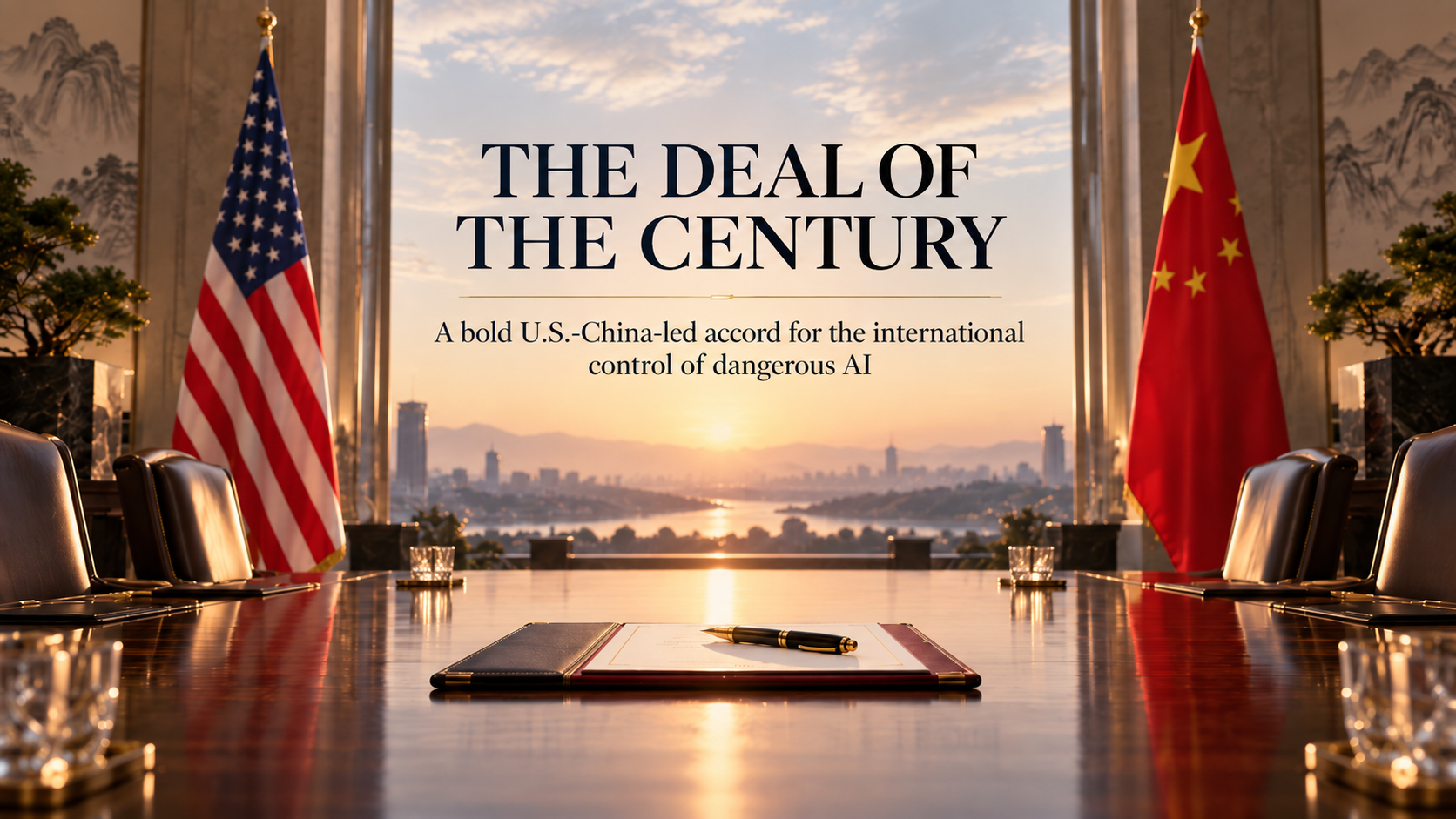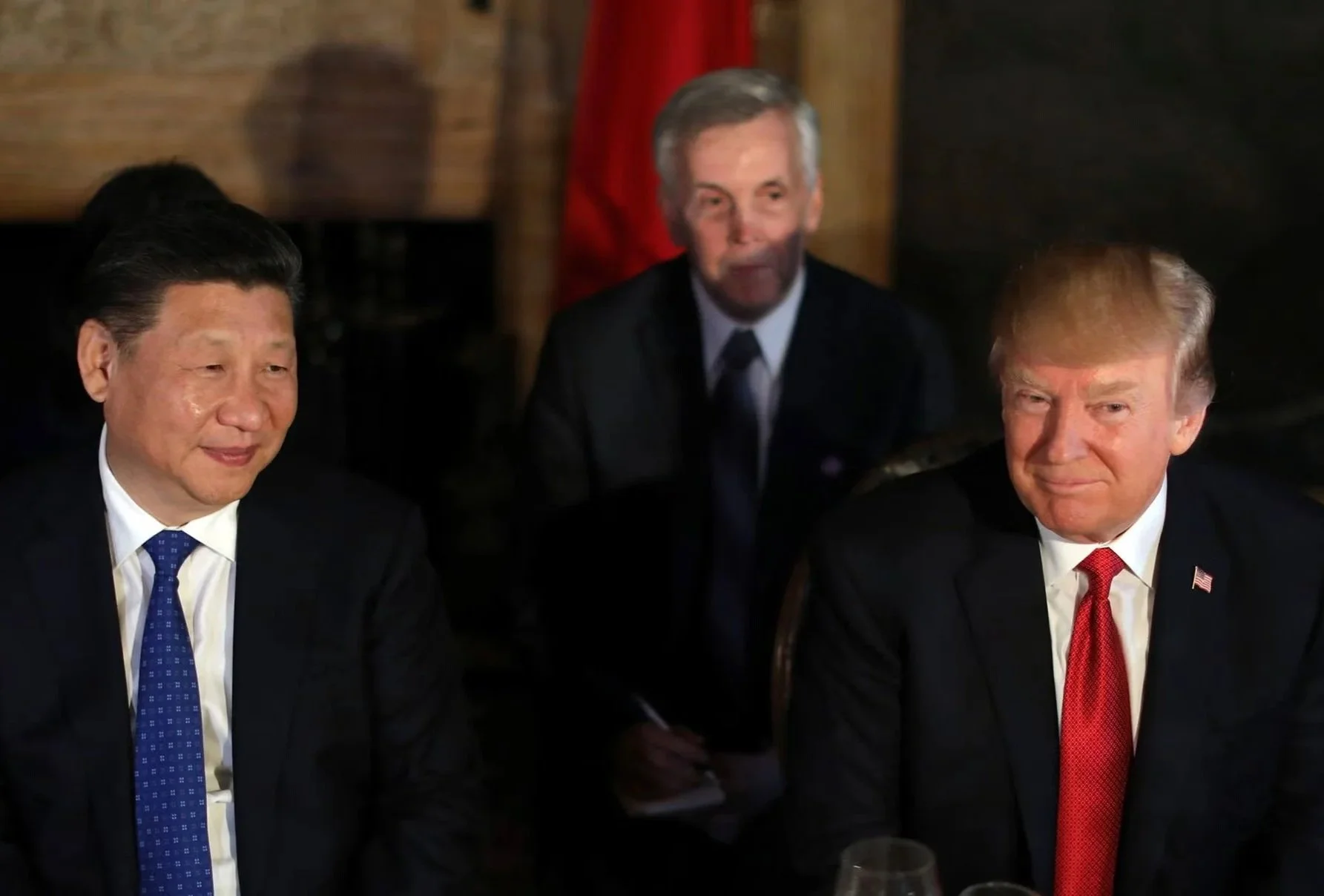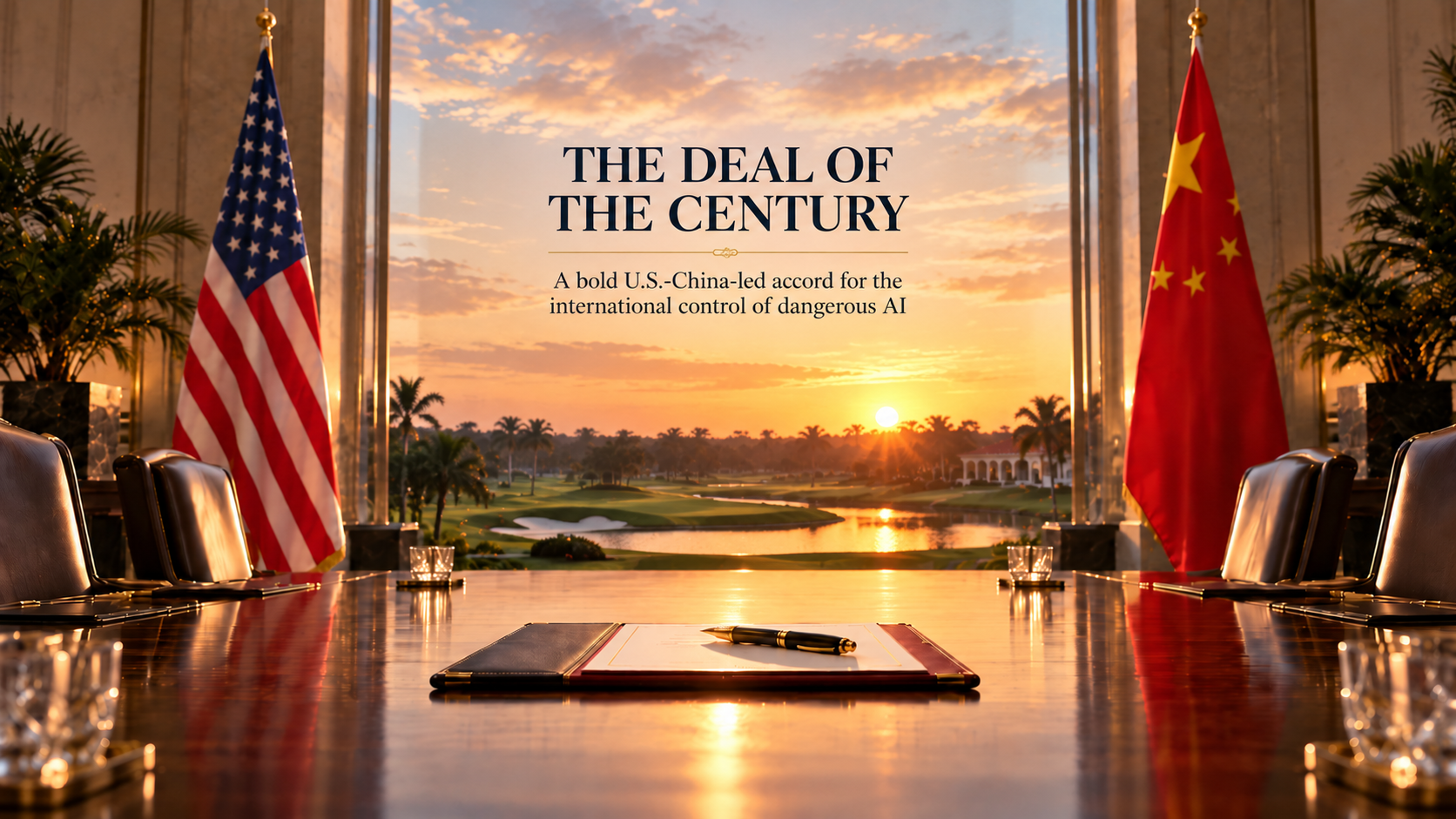
Trump National Doral, Miami — G20 venue, December 14–15
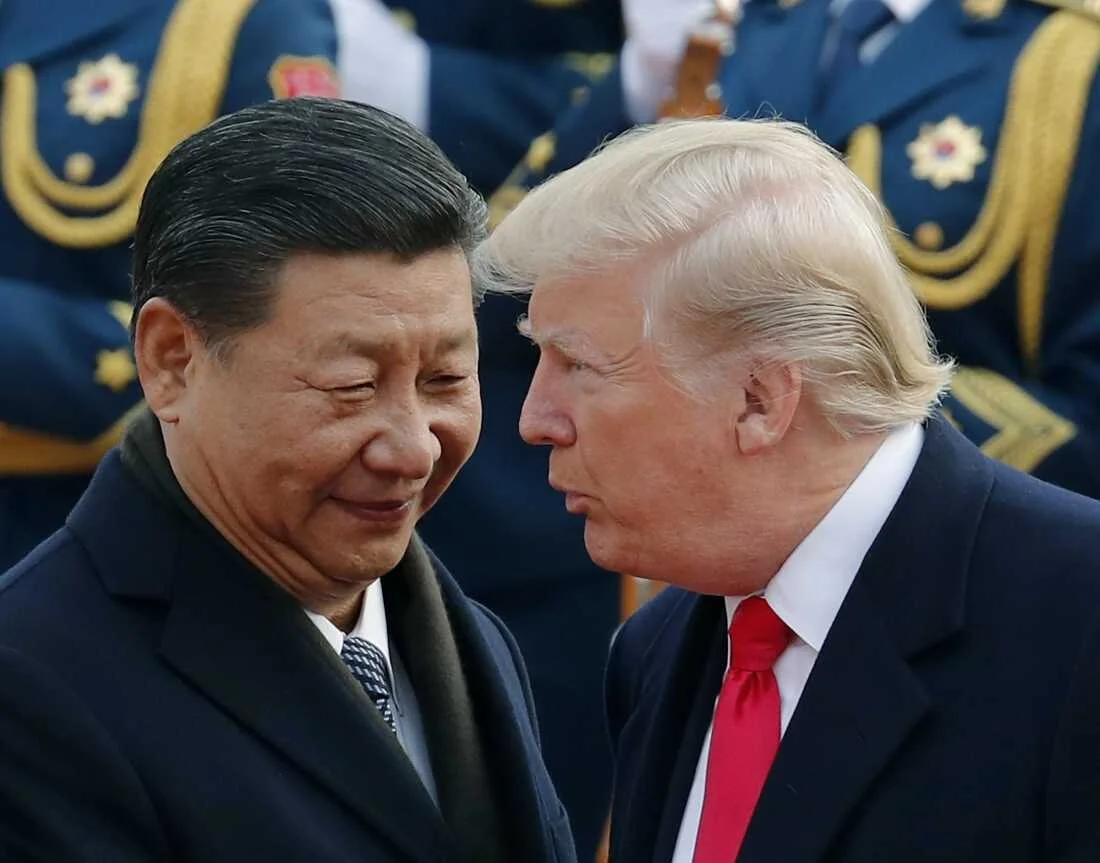
When Trump reaches for a bold AI deal with Xi, a wise and shared plan should already be on his desk.
We are an international coalition that drafts strategic memos and convenes the senior staff of a dozen key US AI policy powerbrokers. We aim to prepare them to help Trump co-lead an extraordinarily bold, well-designed, US-China-led AI treaty.
The President's AI policy is shifting. The hands-off first year kept America ahead, but it can no longer hold. Recently he signed an executive order on AI safety, held the leading lab back for weeks, and had the labs sign a slim Accord on self-policing. On October 4 he created the Super Intelligence Force. Its job is to craft a shared new AI policy with the labs, now united behind Amodei's We Must Pace the Frontier, and with the other key stakeholders.
The China channel lags. Xi calls for institutions that "constantly refine measures to forestall loss of control." Bessent's November dialogue has a single agenda item: "exchange views on AI benefits and risks." That gap is both the risk and the opening.
Trump moves fast once he decides — Operation Warp Speed is the proof. When he does, he will rely on his closest advisors and on plans built for the purpose. We are drafting one with their delegates. It reconciles safety, national security, the economy, markets and his base, so that a critical mass of powerbrokers can back it and Xi can largely sign it.
≈350-page Strategic Memo · 150 pages of powerbroker profiles · 95+ powerbroker staff and advisors engaged · 9 NGOs, 22 advisors, 24 contributors · $7,500/month, all in
Support or join. $60,000 funds the next six months; $800,000 funds an 18-month scale-up. Send a delegate to the Consultations, or suggest who should be in the room. Meet us →
Laser-focused on The Deal of the Century since 2024
Getting Trump to sign an extraordinarily bold AI deal with Xi has been our sole focus for almost two years. On December 18, 2024, we launched with a 90-page strategic memo and an Open Call for a Coalition for a Baruch Plan for AI, whose abstract reads:
"We call on all heads of state, President-Elect Trump and President Xi, and their advisors and security agencies to engage in an open global treaty-making process for safe and fair AI of radically unprecedented scope, urgency and effectiveness."
By February 2025 we had concluded that it would come down to Trump and Xi. The bottleneck was Washington: one President and the dozen people who shape his AI policy. So we spent six months on a memo built to persuade them, and a year engaging their staff.
What we built
For nearly two years we have assembled assets that, as far as we know, no other organization holds in one place:
Unmatched Knowledge Base. A 356-page Strategic Memo based on 950+ articles, videos and papers, 24 contributors, regularly updated via executive summaries. It covers the technical and constituent challenges of a treaty of this scope: verification and enforcement, secure diplomatic infrastructure, treaty-making models, sequencing from bilateral to global, safeguards against capture.
Power-broker intelligence. The memo also includes 150 pages of profiles of a dozen officials, lab leaders, media, political and religious figures who shape Trump's AI policy — including their own stated predictions about AI.
A network one step from the decision. Remotely and via two US tours, we engaged 95+ advisors, staff and envoys — including over 30 hours with senior AI staff or advisors who report directly to Dario Amodei, Pope Leo XIV, Marco Rubio and Michael Kratsios.
Deep roots. Since 2015, our director has led pioneering work on verifiable, trustworthy IT and its international governance — via the Trustless Computing Association, its TRUSTLESS.AI spin-off, and the Free and Safe in Cyberspace series.
Where we stand
We are for a treaty — not for any treaty. Our compass is closest to OpenAI’s and Anthropic's current positions: take catastrophic risk extremely seriously, are deeply concerned about an improper treaty, believe in AI's astounding benefits, and want to prevent a dystopian human power grab. And one conviction of our own: a proper AI safety treaty and a durable citizen stake in AI's wealth need each other. Neither holds without the other.
A treaty is an intervention, and interventions can be net negative. We test ours against four failure modes — a human power grab, a failure to contain AI, a global authoritarian turn, a foreclosed future — each with its guard. We hold this as a bet, not a certainty.
Anthropic's Institute warns that "without a global coordination mechanism, companies and governments will have to make difficult decisions about safety while under competitive and geopolitical pressures." Dario Amodei wrote that "global pacing will require cooperation with China." Bill Gates, on the Ezra Klein Show, said it plainly: "you can't rely on the industry to self-regulate here. I mean, it's just insane."
We work where a lab cannot. We are independent of any lab's commercial interest, reach conservative-humanist and national-security circles, and are free to say plainly that only a US-China-led process gets signed.
The gap we fill
The AI-safety community and its philanthropies — Coefficient Giving above all — have funded a world-class body of safety science and brought AI's catastrophic risks into public debate. Far less goes to designing the US–China treaty-making process itself, or to the arena that now decides it: the President who will shape AI policy until at least January 2029, and the dozen people he listens to. Others made that bet early.
Nvidia's Jensen Huang puts Trump on speakerphone at tech summits. Alumni of Peter Thiel's network hold key tech-policy posts (Memo v2.6). Both reaped outsized returns. We fill that gap at a tiny fraction of the cost — with one test for every step: could it fuel a treaty in the wrong direction? If so, we don't take it.
Preparedness beats prediction
Nobody knows whether the window opens before the G20 at Doral, after the next incident, or not at all. But if it opens, the President will turn to the people already in the room — and the room is filling. It now holds the Super Intelligence Force, lab CEOs united behind pacing, and a Speaker who calls the warnings "a Chinese psyop." Left to the latter, a treaty becomes a market-access deal with safety language bolted on. Relationships, trust and shelf-ready plans cannot be bought on demand in a crisis.
They are built before. And if no window opens, they still pay off in shared knowledge and readier advisors. In September 1945, War Secretary Stimson urged Truman to approach Moscow directly on international control of nuclear weapons. He had the right idea but too few allies in the cabinet. The moment passed; the race came; we got lucky.
Our role in the months ahead
A shelf-ready deal, by Doral. Between now and the G20 at Doral on December 14–15, we are turning our Strategic Memo into the document nobody else has written: a negotiating position that reconciles the President's goals — keep the boom, keep the lead, keep AI under control, avoid anything that looks like world government — with terms Xi could sign. Its first two pages read as a term sheet; the rest show which power brokers already stand close to it.
We serve the Super Intelligence Force, Secretary Bessent, and the plan the labs themselves have set out. Delegates of the powerbrokers co-edit the memo in closed-door Consultations under the Chatham House Rule — provisionally December 9 (Washington), December 13 (Miami, on the eve of the G20) and January 13 (Washington). If they converge, they can bring it to him together. If not, it stays on file, ready the day he reaches for it.
What it costs
Since 2024, we have raised $140,000 from top AI-safety scientists and expert regrantors: one full-time director, a few part-time junior researchers, plus 1,700+ hours of professional volunteering from our advisors and contributors. On a $7,500-a-month burn rate, our constraint is not access but bandwidth: warm channels to the AI-policy leads of four power brokers, and too few hands to follow up. $60,000 funds the next six months at a modestly increased pace. $800,000 funds an 18-month scale-up — a full-time DC convener, Track II to Beijing, a verification feasibility group — where each dollar does the most.
Donate · Join
A "Baruch Plan for AI"?
On June 14, 1946 — the day Donald Trump was born — the US proposed exclusive international control of all dangerous nuclear technology, the greatest deal ever proposed. It passed the UN Atomic Energy Commission 10–0, then stalled on Soviet opposition in the Security Council. We keep the name for one reason — scope. Nothing smaller than that ambition matches the challenge of AI, even if the world must get there step by step, at a wartime pace. Jack Clark of Anthropic, Jaan Tallinn, ControlAI and Yoshua Bengio invoked it as a model for AI.
Where to go next
The Deal of the Century — what we propose and why it must start small and scale fast. Start here to judge whether we're right.
Consultations — remote and in-person closed-door engagements where power brokers' delegates co-edit the deal. Start here if you might contribute or know who should.
Achievements · Roadmap — what we've done on a shoestring, and what funding unlocks next.
Strategic Memos — ≈350 pages on the process itself, plus the v2.8 and v2.9 executive summaries.
Cornered — the AI treaty scenario Washington must avoid; the shortest read on the stakes (Oct 1).
Recent Blog Posts