Strategic Memo of
The Deal of the Century
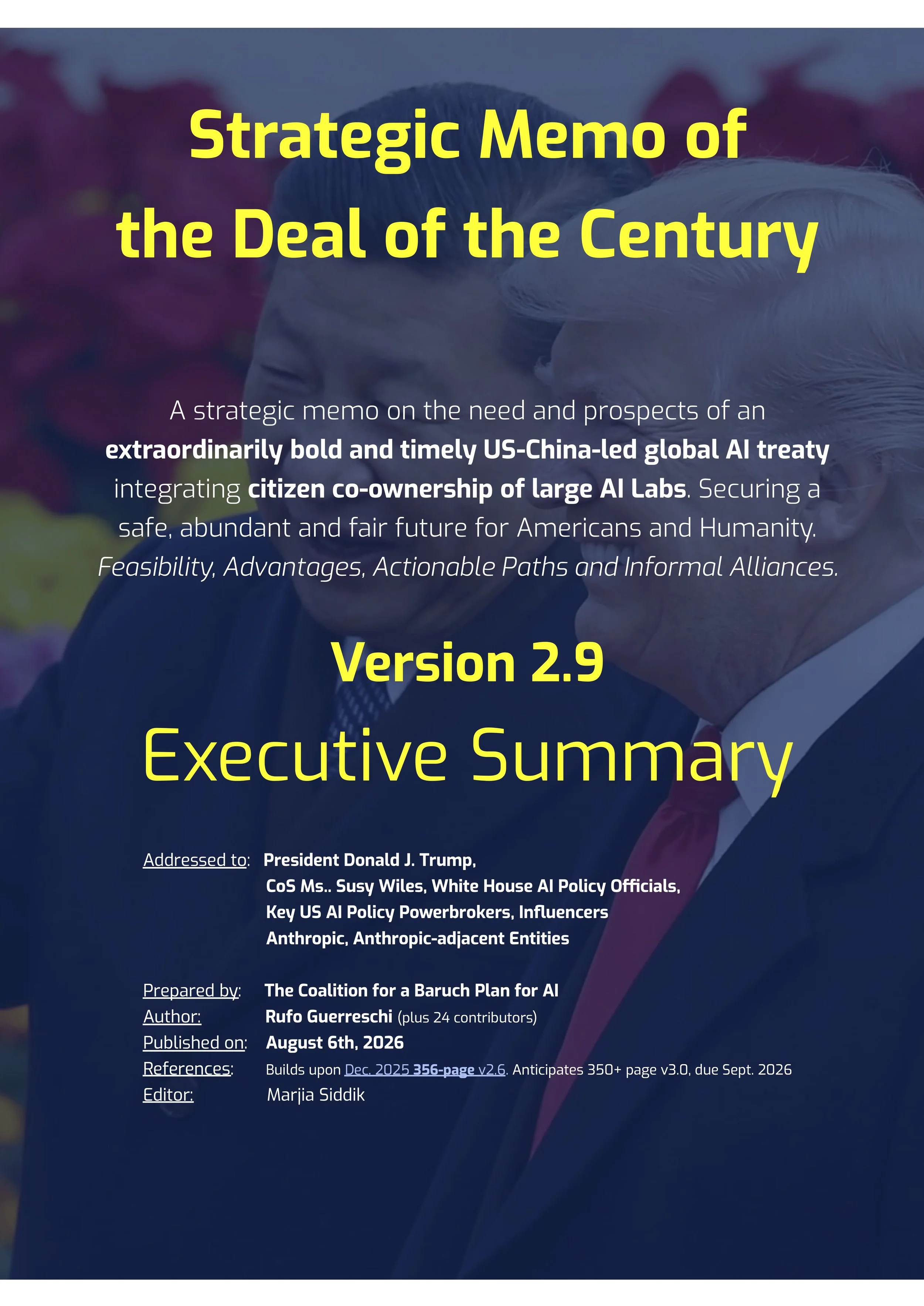
Published on December 30th, 2025, the Strategic Memo for The Deal of the Century (v.2.6) is A key element of The Deal of the Century initiative.
Across 356 pages, the Strategic Memo seeks to persuade and empower a critical mass of key potential influencers on Trump's AI policy to join in an informal humanist AI alliance to persuade Trump — on exclusively realist and pragmatic terms — to co-lead with Xi a bold, timely and proper US-China-led AI treaty-making process.
The Strategic Memo maps a path to build and extend a humanist AI alliance toward techno-optimist influencers, then addresses how to convince, compromise with, co-opt, or outmaneuver post-humanist ones, comfortable with the ASI gamble. Ultimately, it charts convergence among the humanist outlooks of China, major religions, middle state powers and other global power brokers.
The Strategic Memo is addressed to a carefully-chosen set of such influencers as well as potential introducers to them, within and beyond our networks. Hence, it details:
Reasons why Trump can be persuaded
Models and pathways for a successful treaty-making process
Enforcement mechanisms to reliably ban ASI while reducing global authoritarianism
Plans for an ultra-high-bandwidth diplomatic infrastructure
200 pages of actionable persuasion profiles of key influencers of Trump's AI policy
Targeted influencers include Vance, Bannon, Suleyman, Pope Leo XIV, Gabbard, Hassabis, Amodei, Altman, Rubio, Carlson, Rogan, Musk — and possibly Kratzios, Sacks and even Thiel.
The 356-page Memo was created with the contribution of over 24 exceptional contributors over an 11-month period — after having examined almost all pertinent statements made by these influencers including more than 517 articles and videos and over 150 academic papers.
To learn more:
Read its Two-Pager Brief, as published, pasted the Memo cove
Two-Pager Brief
[as published in the Strategic Memo v2.6 on December 30th, 2025]
This strategic memo details why and how Trump could likely be persuaded to pursue the most consequential geopolitical deal in history: a US-China-led global AI treaty that secures US leadership, prevents catastrophic loss of control, and reduces global concentration of power.
History rarely repeats itself, but it often rhymes. As Donald Trump prepares for a pivotal series of meetings with Xi Jinping in 2026, he faces a predicament intimately familiar to Harry Truman in 1946.
Facing post-war economic woes and sinking approval ratings, Truman was confronted in late 1945 by classified briefings warning him of the immense risks of nuclear proliferation and the prospects of thermonuclear war. Today, Trump faces the Artificial Superintelligence (ASI) race: a challenge of even greater magnitude, offering an opportunity for a diplomatic triumph that could define the 21st century.
The Terminal Race for Superintelligence
Most CEOs of leading AI labs are no longer just building tools; they are publicly racing to build ASI — systems that surpass humans at all tasks and improve themselves at an accelerating rate. The scientific consensus is chilling: nearly all experts agree that ASI carries a high risk of human extinction or permanent disempowerment.
While Musk and Amodei warn ASI could arrive even in 2026 and assign a 10-20% probability to human extinction, other top AI CEOs and experts' predictions are not far off. Yet, many of those CEOs disingenuously claim it is plausible that ASIs can be controlled or that the value they will imbue in ASIs will “stick.” They do so, arguably, out of a mix of: wishful thinking; fear that it is too late to stop ASI; fear that global governance could turn into an authoritarian dystopia; and a desire to muddle the waters ahead of a foreseeable massive outcry when the masses will understand what gamble they are taking over our lives without asking.
The Political Disconnect
A staggering 78% of Republican voters believe AI could threaten human existence. As of June 2025, 43% of US citizens are very or somewhat concerned that AI could "cause the end of the human race”. Furthermore, 77% of American voters support a strong international AI treaty — similar to the percentage of Americans calling for international control of nuclear weapons in 1946. Yet, current US policy remains shaped largely by a few accelerationists transhumanist, who welcome a post-human future — a vision deeply at odds with Trump's MAGA base. China has repeatedly called for global AI governance, but Xi Jinping waits for a partner strong enough to lead. This is Trump's opening.
A Date with Destiny
The historical parallels are uncanny. On June 14, 1946 — barely an hour after Donald Trump was born in Queens — President Truman stood before the United Nations to propose the Baruch Plan. It was the boldest treaty ever conceived: placing all dangerous nuclear assets, facilities, and research under exclusive international control, extending it to all other weapons of mass destruction, and enforcing it without any nation's veto.
The plan didn't emerge from idealism. It grew from months of intensive lobbying by a small group of determined advisors — Dean Acheson and Robert Oppenheimer chief among them — who convinced a skeptical, pragmatic president that bold action was the only rational course. The Baruch Plan failed not because the idea was flawed, but because the diplomatic machinery of 1946 was orders of magnitude smaller than the task at hand. Today, that constraint can be overcome.
A similar coalition can help Trump complete what began with his first breath. A "Peace Through Strength" AI treaty would secure a legacy that dwarfs Reagan ending the Cold War and be worth a hundred Nobel Peace Prizes.
The Path Forward
This Strategic Memo proposes The Deal of the Century: a bold, US-China-led global AI treaty that will: secure American economic leadership, durably contain China, halt the uncontrolled race to ASI, and clear the path for safe, AI-driven innovation, leading to unimagined abundance and flourishing — via a Human-First approach favored by the MAGA base.
We discovered that most key influencers of Trump's AI policy share deeply-held humanist values and visions of a "human-first AI". We deeply profiled them, developed arguments that can move them, and created a roadmap for their convergence into an alliance with sufficient critical mass. The window is narrow, but it is open. Just as Oppenheimer and Acheson spurred Truman to act, the right voices today have a historical calling to empower Trump to seize this political moment, turning an existential risk into the greatest deal of his life.
This Strategic Memo serves as the basis for (a) the crafting of direct highly-tailored approaches and communications to influencers and (b) remote and in-person engagements in Q1-Q2 2026, during our Persuasion Tours, that will take us to Washington, DC, the Bay Area, the Mar-a-Lago area, Vatican/Rome, New Delhi and Singapore (see our live Roadmap) – building upon our 1st Persuasion Tour, in DC and the Bay Area in October 2025 (see our recent Achievements).
We are already at work on a follow-up version of the Strategic Memo of The Deal of the Century, version 3.0 due on February 28th, 2026.
Reach out to us or Join Us to help make it even more convincing.