
22 Reasons Why Trump Could Be Persuaded to Co-Lead an AI Treaty
Abstract
The idea that President Trump could champion a bold US-China global AI treaty seems highly unlikely to most. His administration has withdrawn from or threatened 66 international treaties, embraced an "America First" doctrine, and appointed accelerationist AI advisors who view regulation as impediment to American dominance.
Yet this analysis argues the opposite: the very factors driving Trump's aggressive posture—escalating geopolitical competition, his psychology of dominance-through-deals, the accelerating AI race—may actually increase the probability he can be persuaded. A properly framed AI treaty that positions America as dominant architect, advances US interests, and can be sold as "peace through strength" fits Trump's pattern far better than conventional multilateral cooperation.
The historical precedent is striking. In 1946, Harry Truman—a pragmatic, often prejudiced politician who initially dismissed international nuclear control—was persuaded by a small group of advisors led by Oppenheimer and Acheson to propose the Baruch Plan: placing all dangerous nuclear capabilities under international oversight, enforceable without any nation's veto.
This post presents twenty-two factors (listed below) suggesting a narrow but real pathway to what would be the most consequential diplomatic breakthrough since the Cold War. These span Trump's pragmatic psychology (he has acknowledged specific AI risks including deepfakes and rogue AI); the political moment (77% of US voters support a strong international AI treaty); the unprecedented diplomatic calendar (up to four Trump-Xi meetings in 2026); China's consistent calls for global AI governance; and a potential coalition of trusted influencers—Vance, Bannon, Pope Leo XIV, Altman, Rogan—who could shift Trump's calculus.
The window is real but narrow. The question isn't whether Trump should be persuaded, but whether the right coalition can assemble the right message at the right moment—before the window closes.
At first glance, the idea seems absurd.
In the first weeks of 2026, President Trump has threatened to annex Greenland, Canada, and the Panama Canal. He's withdrawn from or threatened to withdraw from 66 international treaties spanning climate, trade, and security. His administration has embraced an explicit "America First, America Only" doctrine that treats multilateral cooperation as weakness. His AI policy advisors lean heavily accelerationist, viewing regulation as an impediment to American dominance.
By any conventional measure, Donald Trump appears to be the last person on Earth who would champion, let alone co-lead, the kind of extraordinarily bold global AI treaty that would be required to prevent humanity from losing control of artificial superintelligence.
Yet here's the paradox: these very factors — the escalating geopolitical competition, Trump's psychology of dominance-through-deals, the accelerating AI race itself — may actually increase the probability he can be persuaded. The same brinkmanship instincts driving his aggressive posture create the conditions for a historic pivot. The same nationalist framing that rejects "globalist" cooperation could embrace "peace through strength" treaty-making that positions America as the dominant architect of AI governance.
History offers a striking precedent. In January 1946, Harry Truman was a pragmatic, often prejudiced politician who initially dismissed Oppenheimer's nuclear holocaust concerns as a cry-baby concerns and appeared to despise Russia as much as Nazi Germany. By June of that year — coincidentally, within an hour of Trump's birth — Truman stood before the United Nations proposing the boldest treaty in history: placing all dangerous nuclear capabilities under international oversight, enforceable without any nation's veto.
What changed? A small group of determined advisors — led by Robert Oppenheimer and Dean Acheson — made the case that bold international cooperation served American strategic interests and political needs. They reframed cooperation as strength, not weakness. They showed Truman how acting first and decisively would secure American leadership for generations.
The question isn't whether Trump shares Truman's worldview. The question is whether the right coalition of influencers can make the case compelling enough to shift his calculus — and whether the diplomatic moment creates sufficient urgency to act.
Below are twenty-two factors that explain why this seemingly impossible persuasion task may actually be achievable. Some factors are about Trump's psychology and political needs. Others concern the strategic landscape, China's position, and the coalition of voices that could move him. Together, they suggest a narrow but real pathway to what would be the most consequential diplomatic breakthrough since the end of the Cold War.
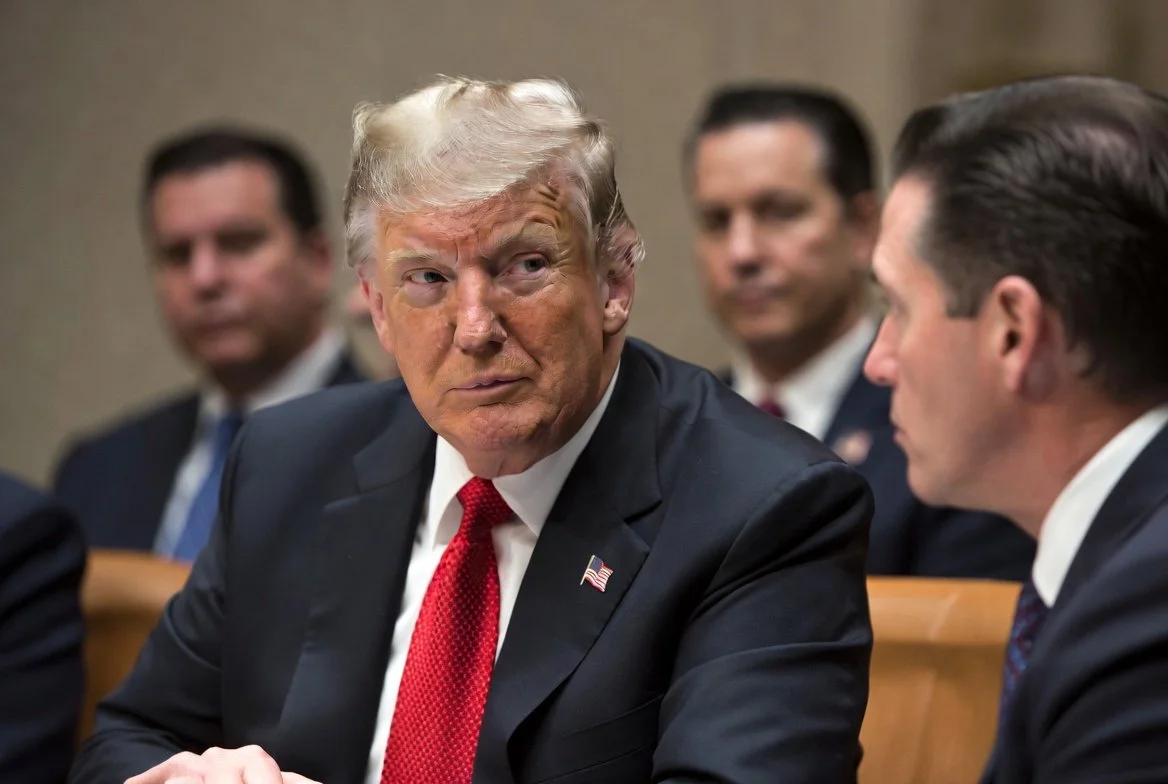
1. Trump is exceedingly pragmatic, guided by survival and fighter instincts rather than ethical or political convictions.
He appears to rely on his instincts and the advice of a few trusted advisors rather than ideological frameworks. He believes in a strong executive and a strong but peaceful US—especially if it includes himself at the center. Critically, he boldly pursues highly unorthodox ideas when suggested by loyal advisors and when those ideas sound good to his instincts and, even more importantly, when they can be sold to his voter base.
This pragmatism means he's not ideologically opposed to bold international moves—he's opposed to moves that make him look weak or subordinate. A properly framed AI treaty that positions him as the dominant architect, that advances American interests, and that can be sold as "peace through strength" fits his pattern far better than conventional multilateral cooperation.
2. Trump has shown no principled opposition to global AI regulation, only to domestic regulation.
While Trump opposes US federal and state regulation of AI, he has shown no interest in global regulation but has not explicitly opposed the possibility of a deal with China on AI. This distinction matters enormously. His opposition to domestic regulation stems from his anti-regulatory business philosophy and his desire to let American companies dominate. But a bilateral US-China treaty that constrains China's AI development while positioning America as the enforcer? That's a different calculation entirely.
The silence creates strategic space. His exceedingly pragmatic character, combined with a shifting political context and decisive advocacy from key influencers, could enable what appears impossible.
3. Trump has acknowledged specific AI risks that only a treaty can address.
Trump has publicly acknowledged the danger of AI deepfakes, specifically expressing fear that a fabricated video of a U.S. president threatening nuclear action could provoke a real nuclear conflict. This isn't abstract risk—it's a scenario that directly threatens his power and legacy.
He's also mentioned the possibility of an AI system "going rogue" and overpowering humanity, although he framed this as hypothetical rather than conviction. Still, the fact that these specific risks are on his radar means the right messaging could elevate them from hypothetical to urgent.
4. Fast-rising public anxiety creates political demand for action.
Public concern has been skyrocketing: In 2023, 55% of citizens surveyed in 12 countries were “fairly” or “very worried” about "loss of control over AI".
By 2025, 78% of US Republican voters believed artificial intelligence could "eventually pose a threat to the existence of humanity".
By March 2025, Americans very or somewhat concerned about AI “causing the end of the human race” were 37% and increased to 43% by July 2025.
In October 2025, 63% of US citizens believe it's likely that "humans won't be able to control it anymore", and 53% believe it's somewhat or very likely that "AI will destroy humanity".
This isn't a fringe position. It's a mainstream voter concern that crosses partisan lines. Republican voters, in particular, show high levels of concern about AI existential risks, creating political permission for bold action.
5. Trump desperately needs a legacy-defining win to raise historically low approval ratings.
With approval ratings hovering around 36%, Trump needs a dramatic achievement that transcends typical policy wins. A drop in his approval, combined with growing public concern about AI, could mirror the political shifts of early 1946, when increased support for international nuclear control led Truman to dramatically change his course.
Trump arguably has substantially more political power as president than his predecessors to influence Congress on a bold shift, especially if it's based on well-grounded national security concerns and has bipartisan public support. But he needs the right framing and the right moment.
6. The unprecedented diplomatic calendar creates maximum leverage.
Trump has accepted Xi's invitation to visit Beijing in April 2026 and reciprocated by inviting Xi for a state visit to the U.S. later that year. Trump may also visit China again in November 2026 for the APEC Summit—potentially four in-person meetings between the two leaders within a year, a level of contact that would be unprecedented.
The next fourteen months will be consumed with preparations for these meetings, creating a structured diplomatic runway for major initiatives. While their October 31st meeting in Busan was largely about sizing each other up, these 2026 summits represent the greatest opportunity for Trump to strike his biggest deal yet.
7. A major AI catastrophic accident could compel immediate action.
The occurrence of a shocking AI accident or incident—a deepfake-triggered international crisis, an AI system causing mass casualties, or further shocking evidence of accelerating AI risks—could compel Trump to act, especially if pressured by voters and trusted advisors. The right plan, ready to deploy in a crisis moment, becomes invaluable.
8. Even winning the ASI race creates catastrophic risks for America.
Preventing proliferation of catastrophically dangerous AI is widely expected to be much more challenging than nuclear weapons—and becomes exponentially harder as AI capabilities spread globally unregulated. Even if the US wins the race for ASI or military-dominant AI, it would likely result in a catastrophic battle of AIs with China, with everyone losing.
The logic is inescapable: no single nation can maintain an ASI monopoly through technical means alone. The technology will diffuse. The question is whether it diffuses in a governed or ungoverned manner.
9. The enormous prosperity AI will bring could diminish the perceived need for winner-take-all competition.
The immense potential "pie" that AI would create—if the pie isn't blown to pieces—would make everyone richer and lessen current incentives for states to engage in economic rivalry at all costs. This shifts the game theory: coordinating to prevent catastrophe becomes rational when the upside is shared abundance rather than zero-sum dominance.
Trump understands deal-making when mutual gains are possible. The challenge is helping him see that AI governance fits this framework.
10. America's current geopolitical isolation could become a strategic weakness.
Eventually, America's geopolitical isolation could become a weakness in the AI age. A "Baruch Plan for AI" could be repositioned as a demonstration of effective, America-led global coordination—a "deal of the century" that secures US leadership, prevents catastrophe, and establishes a unique historical legacy.
This isn't about subordinating American interests to global ones. It's about recognizing that American interests require preventing uncontrolled ASI development and avoiding catastrophic conflict with China.
11. The Pentagon's "wartime mobilization" signals existential stakes—and creates treaty leverage.
The January 2026 Pentagon declaration of "wartime AI mobilization" might seem anti-treaty. In fact, it's pre-treaty positioning. Just as nuclear weapons development preceded arms control, aggressive AI development creates the leverage needed to negotiate from strength.
"Peace through strength" requires first demonstrating strength. The mobilization establishes America's position of dominance—creating the conditions where Trump can negotiate from power rather than weakness.
12. This fits Trump’s signature "brinkmanship-as-bargaining" strategy perfectly.
Trump's approach to AI aligns with his trademark "brinkmanship-as-bargaining" strategy. By initially rejecting something China clearly wants (global AI safety governance), he positions himself to extract major concessions in exchange for eventually agreeing. His pattern of sharp, rapid escalations against China has often served not as a path to open conflict but as deliberate leverage-building before striking deals.
In The Art of the Deal, Trump outlined his playbook: start high, act tough, create leverage, and then negotiate down. What looks like belligerence or erratic escalation is often deliberate—unsettling the opponent, forcing engagement, and making his final proposal appear as their concession. Applied to AI, this means Trump can withhold or even dismiss talk of global governance upfront, using it as a chip to extract favorable terms later.
13. His unpredictability compounds negotiating pressure and creates deal-making opportunities.
By appearing indifferent or even hostile to an AI treaty he might actually want, Trump primes Beijing to treat any eventual deal as a win. His unpredictability compounds the pressure: if talks fail, he blames the other side for "not meeting his terms."
Unlike most leaders, Trump thrives in summit-style negotiation mode and doesn't need extended posturing in advance. He can walk into the Beijing meeting with maximum ambiguity, then pivot dramatically to claim a "historic deal" on his own terms.
14. Trump's foreign policy successes demonstrate deal-making capability when stakes are high.
Some of Trump's foreign policy successes—the Abraham Accords in the Middle East, the historic summit with Kim Jong-un, and pressuring European allies to increase defense spending—show his skill at using US leverage for American and global interests.
These weren't conventional diplomatic achievements. They were bold, unexpected moves that leveraged American power for breakthrough agreements. A properly framed AI treaty fits this pattern perfectly.
15. Trump's treaty ’withdrawal record isn't disqualifying—it's revealing.
Although his record of withdrawing from nuclear treaties during his first term is discouraging, it could be argued that these treaties lacked third-party transparency enforcement mechanisms needed to incentivize compliance by either party and were relatively limited in scope.
Success with a properly designed AI treaty—one with modern verification, enforcement, and benefit-sharing mechanisms—could restore his reputation for negotiating important agreements. This reputation had declined after partial failures in bringing peace to Ukraine and Gaza.
16. China has consistently and repeatedly called for global AI governance.
In July 2025, Premier Li Qiang called for international cooperation on AI, stating that finding balance between development and security risks "urgently requires further consensus from the entire society." This followed several previous Chinese official statements expressing similar positions, including Xi Jinping's Global AI Governance Initiative calling for a "United Nations framework to establish an international institution to govern AI."
China isn't just paying lip service. Their consistent messaging suggests genuine concern about uncontrolled AI development and willingness to engage in serious governance discussions.
17. China is trailing, and its rational leadership recognizes mutual catastrophic risks.
Currently trailing slightly behind the US in AI capabilities while catching up fast, Xi Jinping's rational leadership likely recognizes that the ongoing race could spell disaster even for the eventual winner. Hence, if Donald Trump were to privately and publicly declare his willingness to co-lead a serious global treaty process, Xi Jinping would likely follow.
China's position is strategically similar to the Soviet Union's in 1946—behind but catching up, aware of catastrophic risks, but unwilling to be seen as weak. The key is structuring the treaty so both sides can claim victory.
18. Most other nations would join if the US and China led.
Given growing citizens' anxiety worldwide and the increasing risks of extreme economic and power marginalization for all non-winning AI firms, religious institutions, and nations, most would likely join such a treaty initiative—if assured of reasonable and resilient participation in the treaty-making process, the resulting treaty, and its economic upsides.
US-China leadership isn't sufficient, but it's necessary. Once the two superpowers commit, the diplomatic cascade becomes possible.
19. A small coalition of key influencers could shift Trump's calculus—and that coalition is forming.
Just as a few advisors led by Robert Oppenheimer and Dean Acheson persuaded a skeptical Truman of the Baruch Plan's logic, a small group of trusted, highly skilled entrepreneurs could do the same for Trump.
The potential humanist AI alliance—Vance, Bannon, Pope Leo XIV, Gabbard, Altman, Rogan, and Carlson—represents unified pressure from Trump's base plus Catholic moral authority. If 3-4 of these figures align on a strong, nationalist AI treaty plan and coordinate their approach, Trump will listen.
Most key influencers have already shown support for strong AI governance:
Bannon declared he wants AI treaties "immediately" and will "turbo-charge" the issue
Altman said in 2024 the US "should try really hard" for an agreement with China on AI safety
Carlson asked Musk on-air why he doesn't just "nuke AI" if the extinction risk is 20%
Sacks admitted he thinks "all the time" about superintelligence escaping control
Hassabis called for "something like the UN" for AI
Others deem it "too late" (Musk) or "too hard to get right" (Amodei, Thiel)—but many of these are persuadable positions under the right conditions, not ideological rejections.
(For much, much more, review 200 pages of influencers persuasion profiles in our last Strategic Memo of The Deal of the Century v2.6.)
20. Demonstrating convergence accelerates convergence among influencers.
A crucial secondary effect: knowing that other influencers are closer than they thought to supporting a proper treaty contributes to persuading any individual. No one wants to be first—but everyone wants to be part of a winning coalition.
Even small probability shifts in key decision-makers cascade into massive expected value changes. If there's a 5% chance of shifting Vance's position, and a Vance shift carries a 10% chance of shifting Trump's trajectory, and Trump's shift carries a 20% chance of triggering genuine US-China treaty talks—the compound effect justifies enormous effort.
21. The Trump-Musk conflict creates a strategic opportunity for containment.
In scenarios where Musk's apparent on-off war against Trump continues, Trump could have an extra reason to push for a bold global AI treaty: Trump could use the AI treaty to contain Musk and other lab leaders before they, or their AIs, challenge his power and that of the U.S. government.
As a treaty moves forward, scenarios may emerge in which the U.S. government and an international treaty organization gain decisive authority over xAI and other leading AI labs on national and public security grounds. Since Musk appears to have shifted his full focus and resources to xAI, Trump might be motivated to rein in leading labs before they become uncontrollable.
22. The Baruch Plan coincidence appeals to Trump's sense of historical destiny.
The fact that the Baruch Plan was presented within an hour of Trump's birth adds a narrative of destiny that could appeal to his vanity and legacy consciousness.
Reagan ended the Cold War. Trump could be the president who prevented the AI apocalypse. For a man driven by legacy and historical significance, that framing may matter more than any policy argument. Sometimes, as the saying goes, the right action is taken for the wrong reasons.
Was Truman So Different from Trump?
To be sure, Harry Truman was a different kind of man from Donald Trump. Yet he was also a pragmatic politician, not a globalist idealist.
He was anti-Soviet from the early days, so much so that he stated in 1941, "If we see that Germany is winning, we ought to help Russia and if Russia is winning, we ought to help Germany, and that way let them kill as many as possible, although I don't want to see Hitler victorious under any circumstances."
He held racial prejudices in his early years, even relative to the different standards of his time. The Truman Library itself states that he "was known to have the prejudices of his community when it came to views of race. He used racial slurs, told racist jokes, opposed sit-ins and intermarriage, and called Dr. Martin Luther King a troublemaker."
Yet this same pragmatic, often prejudiced politician—when presented with the right case by the right advisors at the right moment—proposed history's boldest treaty: placing all dangerous nuclear capabilities under international oversight, enforceable without any nation's veto.
The parallel is clear: pragmatic leaders can champion extraordinary international cooperation when it serves their strategic interests and political needs. The question is whether we can assemble the coalition and the framing to make that case compelling enough.
The Path Forward
The window is real but narrow. Trump's April 2026 Beijing visit creates a natural focal point. The accelerating AI capabilities and Pentagon mobilization create urgency. The growing public concern creates political permission.
Our "peace through strength" framing—positioning a US-China treaty as securing permanent American technological advantage rather than constraining American power—resonates with the administration's worldview.
If a critical mass of Trump's trusted influencers unite around a vision for an AI treaty—if they present it as bold, nationalist, moral, and legacy-defining—history can be rewritten. Not just for America, but for everyone.
Trump hasn't acted yet because the narrative hasn't fit him. Give him a bold plan positions America in charge with China on the back foot, comes endorsed by his trusted circle, and appeals to his legacy consciousness — and he may move fast.
The Baruch Plan for AI, framed correctly, can become that plan.
The question isn't whether Trump should be persuaded. The question is whether we can assemble the right coalition, craft the appropriate message, and seize the right moment to do the persuading before the window closes.
This analysis draws from our 356-page Strategic Memo of The Deal of the Century, which profiles each key influencer's interests, philosophy, psychology, and persuadability. For the full strategic framework, persuasion pathways, and detailed treaty proposals, read the complete memo at cbpai.org.
To support this work or join our coalition of 100+ experts and advisors, visit cbpai.org/donate or cbpai.org/join.
